
How to host a climate grief group for your friends
First tip: you don’t have to be a therapist to lead this!
As the environment (and world in general) get more and more terrifying, the BIG FEELINGS can become overwhelming. When I saw the recent photos of the hurricane aftermath in the eastern U.S., or back in the summer with the images coming out of Jasper National Park, part of my brain wants to just shut off. And I shut down.
Unfortunately, when we shut off and shut down, we might also stop helping.
These types of gatherings are helpful for folks fully engaged in climate work, and those who are still on the sidelines.
Attending to the emotional challenges of climate work will not only help the already converted avoid emotional exhaustion, it will also make climate change feel relevant and compelling for some people who are not already engaged.
Sarah Jacquette Ray, A Field Guide to Climate Anxiety
And you don’t have to be a pro to facilitate a group! If you have compassion for the world, you probably have compassion for people as well. And that’s half the work right there. Other top skills are:
- facilitation
- active listening
- rapport building
- trauma-informed care
In my short experience as a peer-facilitator in my own climate group, I know that there are other people out there who feel the same way as you. You are not alone. And I’m sure that even folks with limited experience in climate activism can see that we work on those issues better together than apart.
For all of these reasons and more, it is super important to open up the knowledge, skill-up, and come together to host more formal and informal groups to talk about climate feelings. If we don’t talk, we fall into dispair. That’s bad for us and bad for the actions we could have accomplished if we were feeling more supported.
THE SIX THINGS YOU NEED
I have been hosting Climate Chats for two years now, and I have learned a few things about hosting this type of group. Here are six things I recommend in order to have a successful climate group of your own!
COMMUNITY AGREEMENTS
This is a list of “dos and don’ts” that govern how you all will show up in the space, treat everyone with respect, and deal with any trouble that might arise.
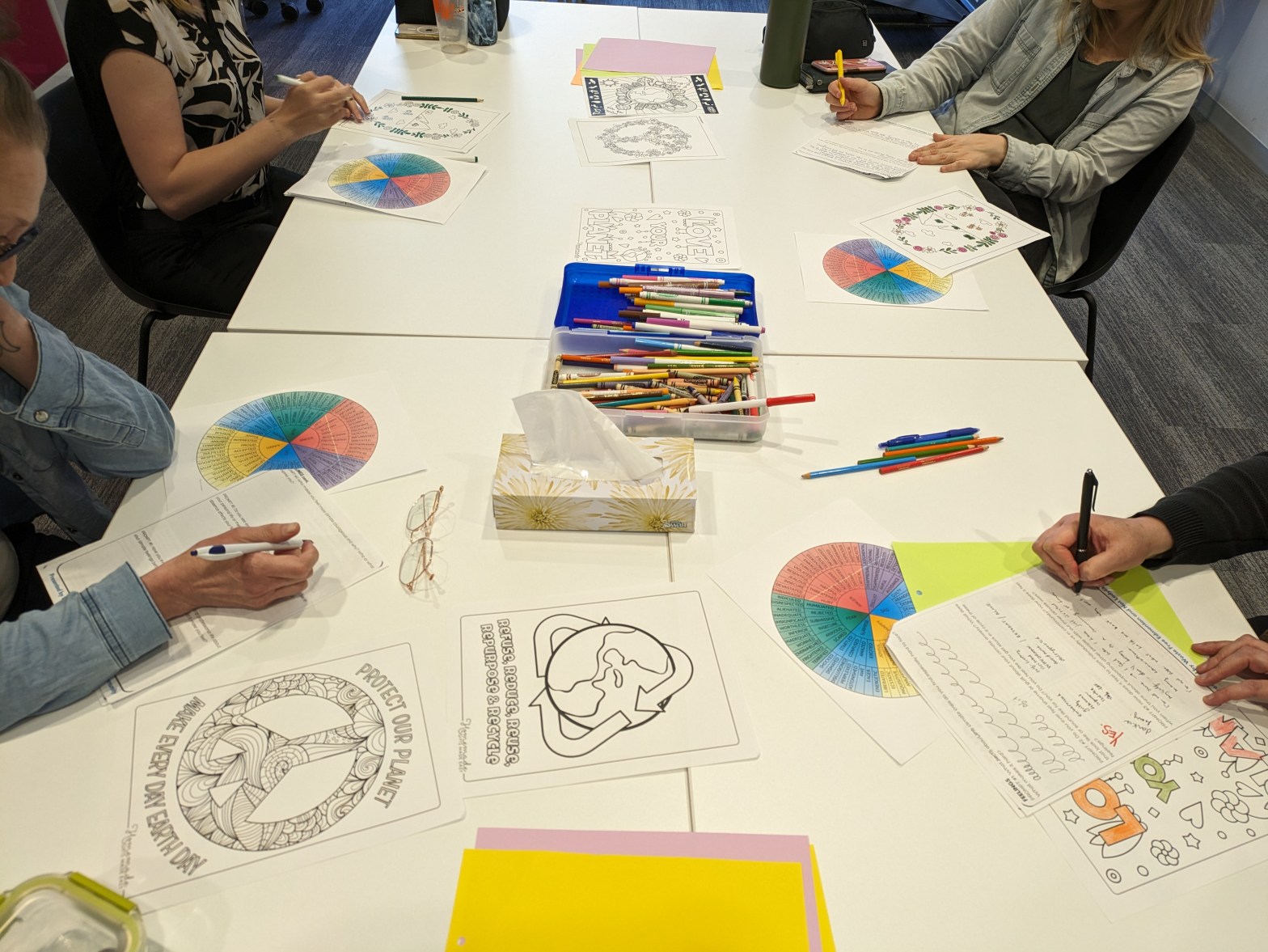
I have worksheets at my events (of course I do), and these are written right at the top of the first page.
You don’t need to have worksheets! I chose to include these in my offering because sometimes people don’t know what to say, don’t want ot say anything out loud, or are so unaware of their feelings (“emotional intelligence”) that they need some prompts to do the work.
If you are hosting this with pals, co-workers, or family, the closeness of the gorup might allow for easier conversations, and more comfortable silences.
COMMUNICATION IS KEY
Not only do you want folks to know what to expect during your time together, but you want them to know it before they arrive. Give lots of notice about the expectations or community agreements, the purpose of the gathering, and what kind of seating arrangements there are.
People are nervous enough to attend events as it is, but even more so when they have no idea what to expect. Unless your friends are the more adventurous type, or you have hosted other soul-baring gatherings before!
This type of gathering is still new to the zeitgeist, and folks might have a lot of questions. Offer to answer any questions however your group likes to communicate – messaging app, email, group chat.
PRIVATE SPACE
Please find a private space to host in. Online or in person. People will cry–sometimes ugly cry–and I personally can’t imagine bawling my eyes out at a cafe.
If you want folks to truly open up, say the things on their mind, you do them a disservice to host in a public space with stranger’s eyes and ears on them.
Not only might people be wary of crying in public, but they might not say what is truly bothering them out of fear of eavesdropping. The opposite is true as well, as public spaces are usually noisy and soft speakers might not be heard by the whole group in the loud environment.
A private space offers intimacy, closeness, and respect. Consider your living room or a study room at your local library.
HAVE A PLAN
Consider what issues might come up in the group, and make a plan in advance for how you might deal with them. Here are some examples of what I mean:
- Do you have a friend or family member who likes talk and talk and talk, and doesn’t know when to stop? Devise a way to ensure equal sharing, like a talking stick or rock. This is an easy and respectful way to let people know they can take their time without taking up ALL the time. They have to pass the rock! Don’t choose a timer, as that will make some folks feel rushed or forced to speak when they aren’t yet ready to share.
- Circling back to community agreements, do you have a friend or family member who likes to argue? Creating a list of community agreements around respectful discourse or how you will be ending arguments (or argumentative interruptions) helps soooo much, especially if you read these at the beginning and get buy-in or contributions from everyone. If an attendee starts to rail on the uselessness of beach clean ups (or whatever), you can gently say: “Sorry to interrupt, but do you remember at the beginning when we agreed we wouldn’t insult people’s personal activism choices? It feels like we’re going in that direction, and I’m wondering if there is a different way you could express your feelings right now…”
- Tell everyone the purpose of this gathering in advance. This includes why you convened them, and what you hope they achieve with the session. Make sure everyone knows that no one is going to be cured of their big feelings–probably.
- Have a list of prompts or questions ready if you encounter an awkward silence. Contemplative silence is probably fine in a group like this, especially if someone drops a huge wowza moment! Awkward silence hits different, and your group might need a prompt to move passed it. Scroll to the bottom of the post for a few easy ones that I really like to use to get the conversation flowing again.
FRAMEWORK
In fact, maybe you want to be completely prompt based! It’s really up to you, and deciding how much of a framework you want, or need is a great way to ensure your specific attendees feel taken care of. And feel like this was worth their time. Climate Chats has a defined agenda, and we use worksheets with journaling prompts to get people thinking about their feelings in very specific ways.
Perhaps your friend group is already really good at talking about their feelings and you won’t need worksheets or prompts. If you have a lot of introverts, shy folks, or a mix of generations, I find that prompts are really helpful.
A mix is good too, either with a few prompts on standby or one guiding question to reflect on, with freeform sharing taking up most of the time. Here is one question that I think every group should have.
END STRONG
End your session with a grounding breath and a quick feelings check-in before folks head out.
Every session I attended when training to be on the crisis line for our local sexual assault centre ended with a feelings check-in. We covered some heavy topics, and our trainers didn’t want to send us out in the world feeling raw and extra vulnerable.
Something as simple as: “let’s go around the circle and everyone share a word to describe how they’re feeling now” can be really powerful.
If you hear any words that indicate you’ve got a friend who is struggling to leave the session behind, you can address it privately with them before they leave the room. Remember my first tip? You don’t need to be a therapist to lead this. I stand by this! If you can tap into your compassion, have active listening skills, and are confident in critical conversations, you’ve got this!
You AREN’T solving climate change or curing your friends of their sadness, grief, anxiety or other big feelings.
You ARE offering a compassionate space for people to address those big feelings, see that they are not alone, and move through the feelings into action.
Individual helplessness becomes group effort, grief becomes possibility, as we let our world transorm us into who we need to be, together, now.
Kate Schapira, Lessons from the Climate Anxiety Counselling Booth
Disclaimers
I only have a few “disclaimers” when I hosts my groups. Consider these for yourself as well.
- If people’s daily lives are being detrimentally impacted by their climate feelings, that is beyond the scope of my gathering and I refer people to find a climate aware psychologist or other mental health specialist.
- Don’t get into arguing about how to solve climate change. This is not debate class, and y’all are not expert climate scientists (probably).
- Be aware of “empathy”, “hope” and “safety”. You cannot fully know what someone else is feeling, and putting yourself in their shoes only ends up with two depressed people. Compassion is a better word to use here. You cannot create a “safe space” for everyone because you don’t know what safety looks like for everyone. I recommend avoiding that word entirely, and focus instead on how you will ensure equal sharing and respectful discourse. If an attendee does or doesn’t feel safe, that is up to them to decide and to name. Offering to discuss after the event what made them feel unsafe or disrespected could be useful feedback for future gatherings. Hope is a dangerous concept and has been weaponized to avoid doing the work. I am still learning about this, but I am now trying to avoid promising hope or hopefulness in my sessions.
FURTHER READING AND RESOURCES
Here are a few sources that have highly informed and influenced my work in this space.
- Generation Dread by Britt Wray
- Lessons from the Climate Anxiety Counselling Booth: How to Live With Care and Purpose in an Endangered World by Kate Schapira
- A Field Guide to Climate Anxiety: How to Keep Your Cool on a Warming Planet by Sarah Ray
- Good Grief Network
- All We Can Save circles
- Climate Psychology Alliance
- Various climate cafes and groups, and newsletters
 Not Ladylike Community